Self Cleaning Street Lamp Research Dust Resistant Lamp Project Exist
A Powerful Exploration of Smart, Sustainable Lighting Solutions for Dust-Heavy Environments

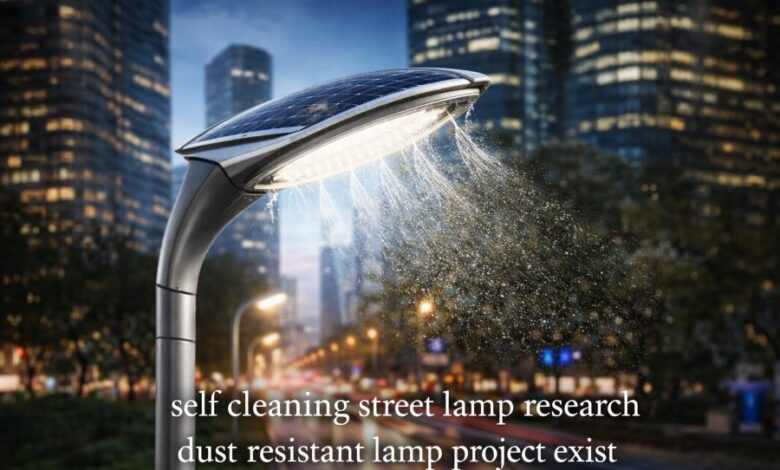
Introduction
Urban infrastructure is evolving rapidly, and street lighting is no longer limited to basic illumination. One of the most discussed innovations today is the self-cleaning street lamp, especially in regions where dust, pollution, and harsh weather significantly reduce lighting efficiency. The idea that a dust-resistant lamp project exists is no longer speculative; it is now a researched, engineered, and partially deployed reality.
Research into self-cleaning street lamps focuses on reducing maintenance costs, improving energy efficiency, and ensuring consistent illumination in challenging environments. While these systems offer impressive benefits, they also come with technical and economic limitations that must be understood clearly. This article provides a complete, balanced, and research-based overview of whether self-cleaning street lamp projects truly exist and how far this technology has progressed.
Quick Fact: Project Overview
| Aspect | Details |
|---|---|
| Technology Name | Self-Cleaning Street Lamp |
| Primary Purpose | Automatic dust and dirt removal |
| Core Application | Solar and LED street lighting |
| Key Feature | Dust-resistant and low-maintenance design |
| Research Status | Experimental to commercial deployment |
| Ideal Environments | Desert, industrial, polluted urban areas |
Understanding Self-Cleaning Street Lamp Technology
What Does “Self-Cleaning” Mean in Street Lighting?
A self-cleaning street lamp is designed to minimize or eliminate manual cleaning by automatically reducing dust accumulation on critical surfaces such as lamp covers and solar panels. Dust accumulation can lower light output and reduce solar charging efficiency, making cleaning a necessity rather than a luxury.
The concept does not always imply complete removal of dirt but rather maintaining optimal performance for longer periods. Some designs rely on passive cleaning methods, while others use active mechanical systems. Both approaches aim to address the same core problem: performance degradation caused by dust.
Why Dust Resistance Is a Critical Research Area
Dust is one of the biggest challenges for outdoor lighting systems, particularly in arid and semi-arid regions. Even a thin layer of dust can reduce solar panel efficiency by a significant margin and dim LED output over time.
Researchers focus on dust resistance because it directly impacts operational costs, public safety, and sustainability goals. A lamp that cleans itself reduces maintenance cycles, lowers labor costs, and ensures reliable lighting in remote or high-risk locations.
Key Research Approaches in Self-Cleaning Street Lamps
Surface Engineering and Advanced Coatings
One major research direction involves special surface coatings that prevent dust from sticking. These coatings are engineered to be hydrophobic or low-adhesion, allowing dust particles to slide off naturally due to wind, gravity, or light moisture.
This approach is attractive because it has no moving parts, making it energy-efficient and durable. However, coatings can degrade over time, especially in extreme heat or high UV exposure, which limits their long-term effectiveness.
Mechanical and Automated Cleaning Systems
Another prominent research path includes mechanical self-cleaning mechanisms. These systems typically use motor-driven brushes or wipers that periodically sweep dust off solar panels or lamp covers.
Mechanical systems are more effective in heavy dust environments, but they introduce complexity. Moving parts increase the risk of wear and mechanical failure, which researchers actively work to minimize through lightweight materials and smart control systems.
Do Self-Cleaning Street Lamp Projects Exist?
Research Prototypes and Field Trials
Yes, self-cleaning street lamp projects do exist at the research and prototype level. Universities, engineering institutes, and smart-city initiatives have developed working models that demonstrate automatic dust removal using low-power mechanisms.
These prototypes are often tested in controlled or semi-real environments. Results show clear improvements in lighting efficiency and reduced maintenance frequency, confirming the feasibility of the concept.
Commercial and Semi-Commercial Implementations
Beyond research, some manufacturers have introduced dust-resistant and self-cleaning street lamps into the market, particularly in solar lighting solutions. These systems are typically deployed in regions where manual cleaning is costly or impractical.
While not yet universal, their existence confirms that the technology has moved beyond theory. Adoption remains selective due to cost considerations and varying environmental needs.
Advantages of Self-Cleaning and Dust-Resistant Street Lamps
Improved Performance and Energy Efficiency
The most significant benefit is consistent performance. By preventing dust buildup, lamps maintain their designed light output and solar charging efficiency over extended periods.
This directly supports sustainability goals by reducing energy waste and ensuring that renewable energy systems perform at their best.
Reduced Maintenance and Operational Costs
Automatic cleaning significantly lowers the need for manual labor and specialized maintenance equipment. This is especially valuable in remote highways, industrial zones, and desert regions.
However, initial installation costs can be higher, which sometimes discourages large-scale adoption despite long-term savings.
Limitations and Challenges in Current Research
Cost and System Complexity
One negative aspect of self-cleaning street lamp projects is their upfront cost. Adding sensors, motors, or advanced coatings increases manufacturing expenses, which can be a barrier for budget-constrained municipalities.
Researchers are actively working to simplify designs and reduce costs, but widespread affordability remains a challenge.
Environmental and Mechanical Durability
Extreme temperatures, sandstorms, and humidity can affect both coatings and mechanical systems. Long-term durability under real-world conditions is still an active area of study.
These limitations do not invalidate the technology, but they highlight why adoption is gradual rather than immediate.
Future Direction of Self-Cleaning Street Lamp Research
Integration with Smart City Systems
Future designs increasingly integrate self-cleaning lamps with smart monitoring systems. Sensors can detect dust levels, trigger cleaning cycles, and report performance data remotely.
This makes the technology more adaptive and cost-effective, aligning it with broader smart-city infrastructure goals.
Material Innovation and Passive Cleaning
Ongoing research in material science aims to develop longer-lasting coatings that require no mechanical assistance. If successful, this could dramatically reduce costs and increase adoption.
Such advancements may represent the tipping point for global implementation.
Conclusion
Self-cleaning street lamp research clearly shows that dust-resistant lamp projects do exist, both as research prototypes and limited commercial solutions. These systems offer strong advantages in efficiency, sustainability, and maintenance reduction, particularly in dust-heavy environments.
At the same time, the technology is not without challenges. Higher initial costs, durability concerns, and system complexity slow down mass adoption. Still, ongoing research and smart-city integration suggest a positive future where self-cleaning street lamps become a standard rather than an exception.
Frequently Asked Questions (FAQ)
What is the main purpose of a self-cleaning street lamp?
The primary goal is to reduce dust accumulation automatically, maintaining lighting performance and minimizing manual maintenance.
Are self-cleaning street lamps fully autonomous?
Most designs are semi-autonomous, using sensors or scheduled cycles, while some rely on passive cleaning methods.
Do dust-resistant street lamp projects exist today?
Yes, they exist as research prototypes and limited commercial implementations, especially in solar street lighting.
Are these lamps suitable for all environments?
They are most beneficial in dusty, polluted, or remote areas. In low-dust environments, traditional lamps may be more cost-effective.
Will self-cleaning street lamps become common in the future?
With ongoing research and falling technology costs, wider adoption is likely, especially in smart-city projects and renewable energy infrastructure.